


Delphi, the navel of the world, the legend of the oracle told as if you were right there

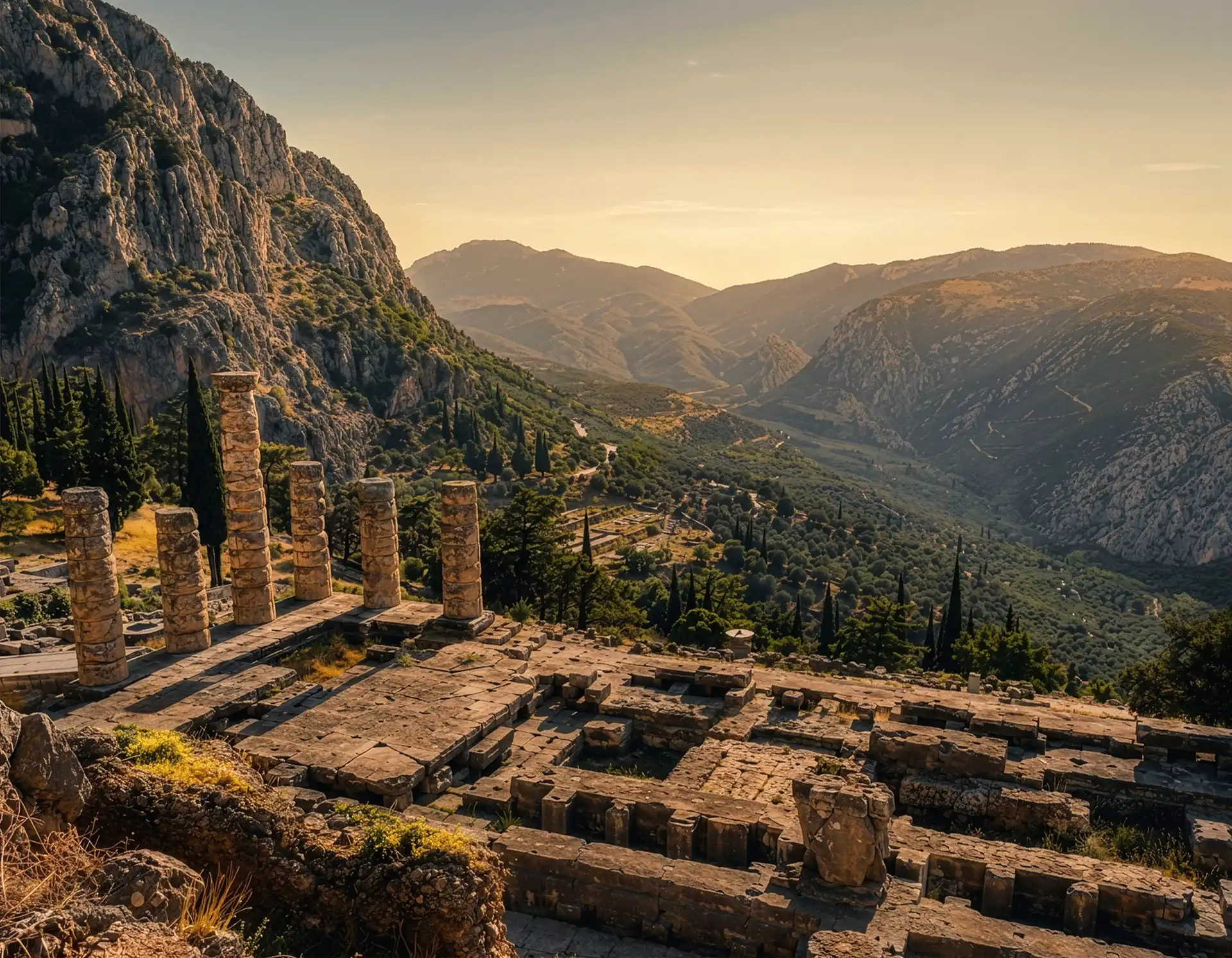
Tour to Delphi from Athens, Temple of Apollo at sunset

If you're thinking about taking a Delphi tour from Athens, there's a legend you should know before heading up.

Zeus wanted to know where the center of the world was. So he released two eagles, one from the eastern edge of the earth and the other from the western, and let them fly in a straight line toward each other. They met hovering over the slopes of Mount Parnassus. Right there, the Greeks said, lies the navel of the world. And right there, they built Delphi.

That stone marking the exact spot—the omphalos, literally “navel” in Greek—can still be seen today in the site’s museum, designated a UNESCO World Heritage Site. But what truly makes Delphi special isn’t the stone. It’s what used to happen a few meters higher up, in the Temple of Apollo, where for centuries the most powerful men in the Mediterranean climbed to ask just one question: what should I do?

The woman who spoke for a god

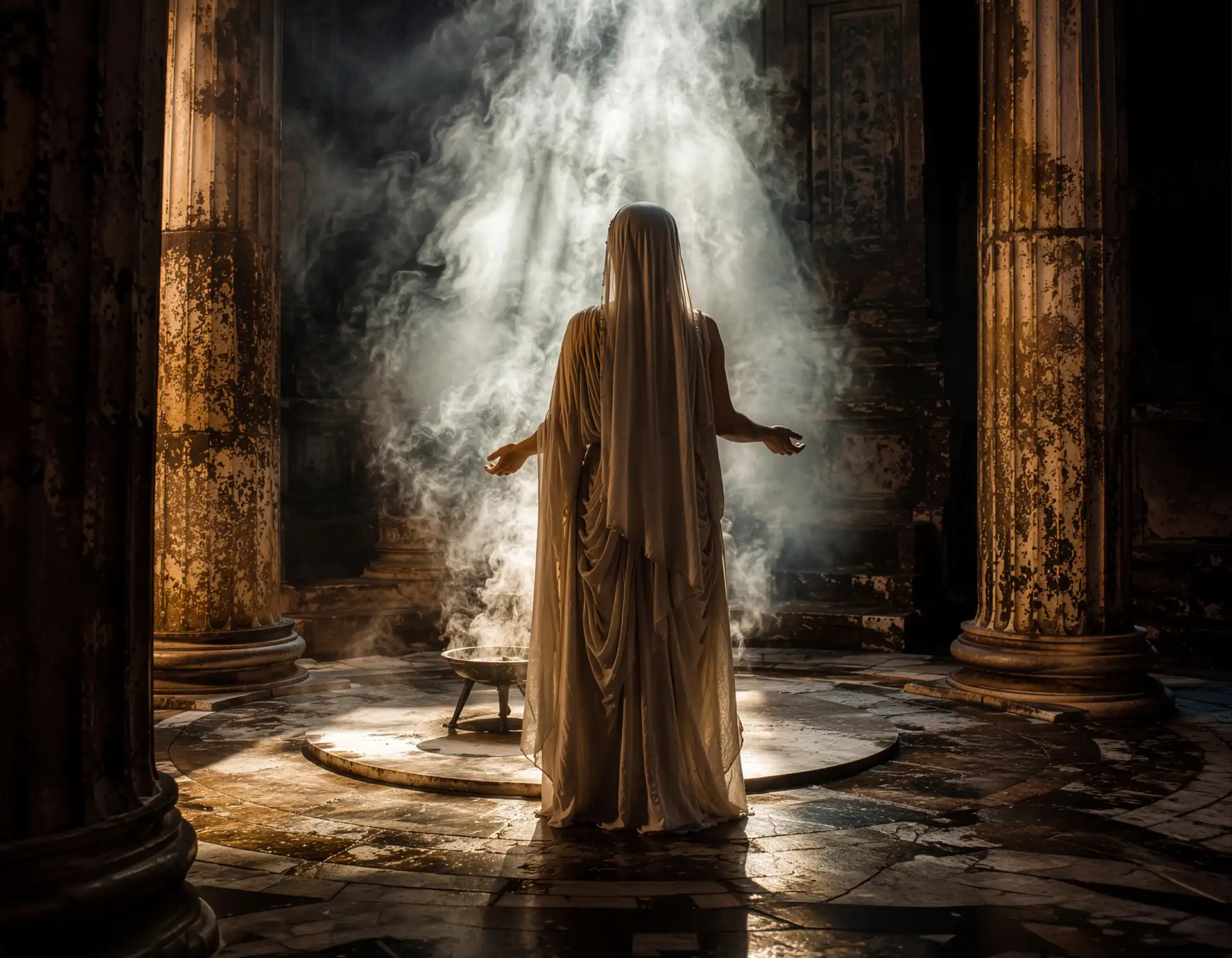
At the heart of the sanctuary lived the Pythia, a priestess who would enter a trance state—the ancients believed by inhaling vapors rising from a chasm in the rock—and utter the words of Apollo. Her answers were almost never a simple yes or no. They were ambiguous, double-edged, and sometimes cruel in their ambiguity.

The most famous case: King Croesus of Lydia asked whether he should attack the Persian Empire. The oracle replied that if he did, he would destroy a great empire. Croesus attacked. The empire he destroyed was his own. Nobody had told him which of the two empires the prophecy was referring to.

That is what made this place so feared and respected: it didn't tell you what you wanted to hear, it told you the truth in a way you only understood afterward.

Oracle of Delphi, a myth you will discover on your tour from Athens

A place built to leave you speechless

Climbing up to Delphi today means understanding why this exact location was chosen. It's not a temple on a flat plain; it's a sanctuary that climbs the mountain slopes, overlooking an olive grove valley that sweeps down to the sea. When ancient pilgrims arrived after days of traveling, this was the first thing they saw: the Sacred Way winding up between the treasuries built by different city-states to show off to the gods (and to their rivals), all the way up to the Temple of Apollo, and even higher, to the theater and the stadium.

Delphi wasn't just an oracle. It was where the Pythian Games were held every four years—one of the four major Panhellenic festivals, nearly as important as the Olympic Games. During those days, all of Greece—a land usually divided into rival city-states at war with one another—laid down its weapons and journeyed up here.

Two phrases that are still standing

At the entrance to the Temple of Apollo were two maxims attributed to the Seven Sages of Greece: “Know thyself” and “Nothing in excess.” They aren't just pretty words carved into ancient stone. They are, quite likely, the most repeated piece of advice in the history of Western philosophy, and they were born right here—at the gateway to a temple dedicated to an oracle who spoke in riddles.

There's something deeply endearing about that: the most mystical and ambiguous place in ancient Greece was also the one that left behind the clearest, most honest advice ever written.

Delphi Tour from Athens: What You Need to Know

Why is Delphi said to be the “navel of the world”?

According to the myth of Zeus's two eagles, this was the point where both birds met, marking the geographic and spiritual center of the known world for the ancient Greeks.

How long does it take to get from Athens to Delphi?

The journey takes about 2–2.5 hours by road, crossing the Plain of Boeotia and the slopes of Mount Parnassus.

What can be seen at the archaeological site and the museum?

The Temple of Apollo, the theater, the stadium, the Treasury of the Athenians, and, in the museum, pieces like the omphalos itself and the Charioteer of Delphi, one of the best-preserved bronze sculptures from antiquity. You can find all the official information about the site on the website of the Ministry of Culture of Greece.

Is a private tour worth it?

Yes, mostly because Delphi combines history, mythology, and archaeology in layers that are much easier to understand with context. Without a guide, it's easy to walk right past the omphalos without realizing what you're actually looking at.

Our recommendation for your tour to Delphi from Athens

Delphi is not a place you “visit” quickly and check off a list. It's a place that asks you to walk up slowly, with time, and let the landscape tell you what was, for 1,000 years, the spiritual center of the Mediterranean world. We organize it like this, unhurried, because it's the only way for it to stay with you as it deserves.

Sube hasta donde antaño subían reyes a preguntarle su destino a un dios, y entiende por qué este rincón de Grecia se ganó fama de sagrado durante más de mil años.

Check out our Tour to Delphi, the Navel of the Ancient World, and experience it at an unhurried pace, as it deserves.